A Fair Value Gap (FVG) helps traders identify high-probability price retracement areas created by market imbalance.
The Fair Value Gap (FVG) Trading Strategy has become one of the most popular trading methods among beginners and experienced traders. It is based on the idea that the market does not always move in a balanced way. Sometimes price moves so quickly that it leaves an imbalance between buyers and sellers. This imbalance creates a Fair Value Gap, which often acts as an important area where price may return before continuing in its original direction. Learning this concept can help traders make smarter trading decisions instead of entering trades randomly.
If you want to improve your trading skills and understand how professional traders analyze the market, learning the Fair Value Gap (FVG) Strategy is a great starting point. Take time to practice on a demo account, combine FVG with proper risk management, and build confidence before trading with real money. Consistent learning and patience are the keys to long-term success in the financial markets.
In this guide, you will learn what a Fair Value Gap is, how it forms, why it matters, how to identify bullish and bearish FVGs, how to use FVG for trade entries and exits, how to combine it with market structure, common mistakes beginners make, and practical tips to improve your trading performance.
What Is a Fair Value Gap (FVG)?
- A Fair Value Gap (FVG) is an area where price moves quickly and leaves an imbalance in the market.
- It usually appears after a strong bullish or bearish price movement.
- An FVG forms because buyers or sellers become very aggressive.
- The market does not trade evenly during these fast movements.
- This creates a price gap between three candles.
- Many traders believe price often returns to this gap before continuing its trend.
- FVG is widely used in ICT (Inner Circle Trader) trading concepts.
- It helps traders identify high-probability entry zones.
- An FVG is not the same as a traditional market gap.
- It represents market inefficiency rather than missing price data.
- Both Forex, Stocks, Crypto, and Indices can form Fair Value Gaps.
- Beginners should first learn to identify FVGs correctly before trading them.
- FVGs work best when combined with market structure.
- Proper confirmation increases the probability of successful trades.
- Understanding FVG is the foundation of this trading strategy.
How Does a Fair Value Gap Form?
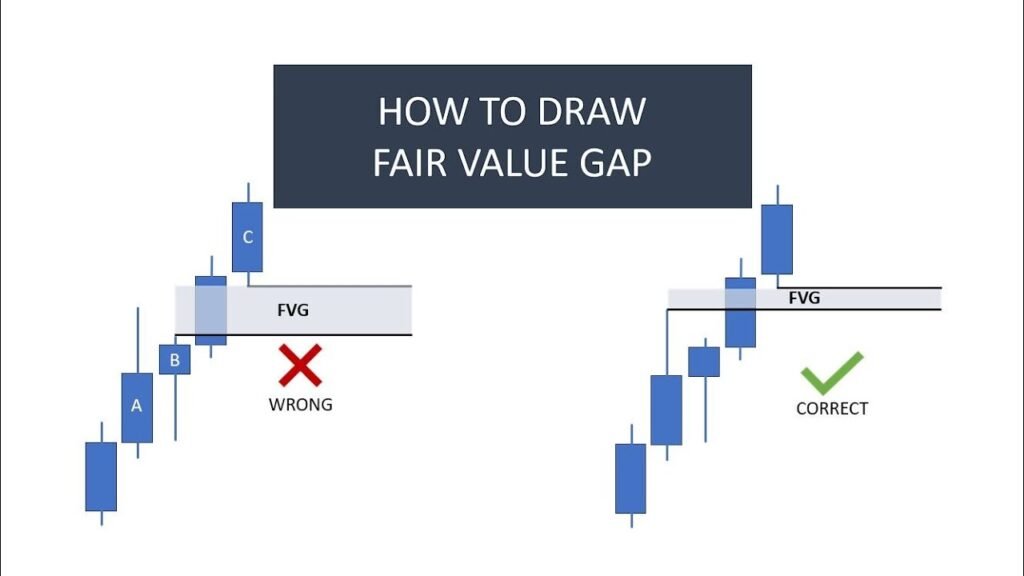
- A Fair Value Gap forms during a strong impulsive move.
- It normally consists of three candles.
- The middle candle is usually very large.
- There is little or no overlap between the first and third candles.
- This lack of overlap creates the imbalance.
- Buyers or sellers dominate the market during this move.
- The stronger the momentum, the larger the potential FVG.
- High-impact economic news can create Fair Value Gaps.
- Institutional buying or selling also creates these imbalances.
- The market often revisits these areas later.
- This revisit is called an FVG retracement.
- Traders wait for price to react inside the gap.
- The reaction can provide a low-risk trading opportunity.
- Not every gap will be respected by the market.
- Confirmation from other trading tools is always recommended.
Why Fair Value Gaps Are Important in Trading
- Fair Value Gaps help traders understand market imbalance.
- They highlight areas where institutions may have entered the market.
- FVGs provide better trade entry locations.
- They help reduce emotional trading.
- Traders can avoid chasing the market.
- They improve risk-to-reward ratios.
- Stop-loss placement becomes more logical.
- FVGs often align with strong support or resistance.
- They can confirm the strength of a trend.
- They help traders identify possible price retracements.
- Many professional traders include FVGs in their trading plans.
- They work on different chart timeframes.
- They support disciplined trading decisions.
- Combining FVG with price action increases accuracy.
- Understanding their importance builds confidence and consistency.
Bullish vs. Bearish Fair Value Gaps
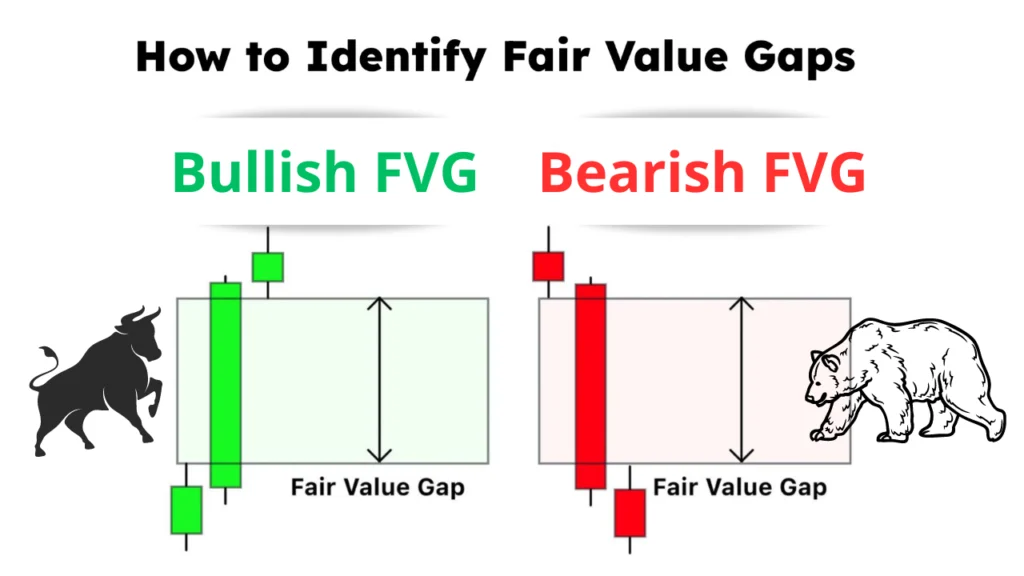
- A Bullish Fair Value Gap appears during an upward trend.
- It forms after strong buying pressure.
- Price often retraces into the gap before moving higher.
- Traders look for buying opportunities inside the bullish FVG.
- A Bearish Fair Value Gap appears during a downward trend.
- It forms after strong selling pressure.
- Price may retrace upward into the gap before falling again.
- Traders look for selling opportunities inside the bearish FVG.
- Always identify the overall market trend first.
- Trading against the trend increases risk.
- Higher timeframe analysis improves trade quality.
- Wait for confirmation before entering any trade.
- Use candlestick patterns to confirm market direction.
- Apply proper risk management on every trade.
- Understanding both bullish and bearish FVGs helps traders adapt to different market conditions.
How to Identify a Fair Value Gap on a Chart
- A Fair Value Gap (FVG) is identified using a three-candle pattern.
- Look for a strong bullish or bearish impulse move.
- The middle candle should have a large body with strong momentum.
- Check whether the first and third candles have little or no overlap.
- The empty price area between these candles forms the Fair Value Gap.
- In a bullish FVG, price moves upward quickly and leaves an imbalance below.
- In a bearish FVG, price drops rapidly and leaves an imbalance above.
- Use the candlestick chart for clearer identification of FVGs.
- Mark the gap with a rectangle to monitor future price reactions.
- Wait for the price to return to the gap instead of entering immediately.
- Confirm the FVG with the overall market trend.
- Strong trading volume often makes an FVG more reliable.
- Combine the FVG with support and resistance for better accuracy.
- Practice identifying Fair Value Gaps on historical charts before trading live.
- Correct identification of an FVG increases the chances of high-probability trades.
Best Timeframes for FVG Trading
- Fair Value Gaps can be traded on almost every timeframe.
- The Daily timeframe provides the strongest market direction.
- The 4-Hour (H4) chart is excellent for swing traders.
- The 1-Hour (H1) timeframe offers balanced trading opportunities.
- The 30-Minute (M30) chart is suitable for short-term traders.
- The 15-Minute (M15) timeframe is popular among day traders.
- The 5-Minute (M5) chart works well for experienced scalpers.
- Beginners should avoid relying only on very low timeframes.
- Always start your analysis from a higher timeframe.
- Use lower timeframes to refine your trade entries.
- Higher timeframe FVGs are generally more reliable.
- Multiple timeframe analysis improves trade quality.
- Match your trading timeframe with your personal trading style.
- Avoid trading during low-volatility market sessions.
- Choosing the right timeframe helps improve consistency and confidence.
How to Trade Fair Value Gaps Step by Step
- Begin by identifying the overall market trend.
- Wait for a strong impulsive move that creates a Fair Value Gap.
- Mark the FVG clearly on your trading chart.
- Allow price to retrace back into the gap.
- Do not enter the trade before the retracement occurs.
- Watch for price action confirmation inside the FVG.
- Look for bullish candlestick patterns in a bullish FVG.
- Look for bearish candlestick patterns in a bearish FVG.
- Place your stop-loss beyond the opposite side of the gap.
- Set your take-profit at the next important support or resistance level.
- Aim for a healthy risk-to-reward ratio, such as 1:2 or 1:3.
- Never risk more than a small percentage of your trading account.
- Avoid opening multiple trades on the same setup.
- Record every trade in a trading journal to track performance.
- Follow your trading plan with patience and discipline instead of emotional decisions.
Using Market Structure with Fair Value Gaps
- Market Structure helps traders understand the overall market direction.
- Always identify whether the market is making higher highs and higher lows or lower highs and lower lows.
- Trade bullish FVGs only in an uptrend whenever possible.
- Trade bearish FVGs mainly during a downtrend.
- A Break of Structure (BOS) often confirms trend continuation.
- A Change of Character (CHOCH) may indicate a possible trend reversal.
- Wait for a confirmed market structure shift before entering a trade.
- Combine Fair Value Gaps with Order Blocks for stronger setups.
- Liquidity zones near an FVG can provide additional confirmation.
- Support and resistance levels strengthen the reliability of an FVG.
- Higher timeframe market structure should guide lower timeframe entries.
- Avoid trading against the dominant market trend.
- Multiple confirmations increase the probability of successful trades.
- Combining Market Structure with Fair Value Gaps helps reduce false signals.
- Understanding both concepts together creates a more disciplined and consistent trading strategy.
Common Mistakes Beginners Make When Trading Fair Value Gaps
- Many beginners enter a trade without understanding what a Fair Value Gap (FVG) actually represents.
- Trading every FVG without checking the overall market trend often leads to unnecessary losses.
- Ignoring Market Structure is one of the biggest mistakes new traders make.
- Entering a trade before price reaches the Fair Value Gap increases risk.
- Trading without confirmation candles can result in false entries.
- Using a very large stop-loss reduces the overall risk-to-reward ratio.
- Placing the stop-loss too close to the entry may cause early stop-outs.
- Risking too much money on a single trade can quickly damage a trading account.
- Trading during major economic news events without caution increases volatility risk.
- Using only one timeframe instead of multi-timeframe analysis reduces trading accuracy.
- Ignoring important support and resistance levels can lead to poor trading decisions.
- Overtrading every small FVG creates emotional stress and unnecessary losses.
- Failing to maintain a trading journal makes it difficult to improve performance.
- Letting emotions control trading decisions often results in inconsistent results.
- Avoiding these common mistakes helps beginners become more disciplined and confident traders.
Risk Management for Fair Value Gap Trading
- Risk Management is more important than finding the perfect trade setup.
- Never risk more than 1% to 2% of your trading account on a single trade.
- Always place a stop-loss before entering a trade.
- Use a realistic take-profit based on market structure.
- Aim for a minimum 1:2 Risk-to-Reward Ratio whenever possible.
- Never move your stop-loss because of fear or hope.
- Avoid increasing your lot size after a losing trade.
- Do not chase the market after missing an entry.
- Protect your trading capital during losing streaks.
- Focus on long-term consistency instead of quick profits.
- Avoid revenge trading after consecutive losses.
- Follow the same risk management rules on every trade.
- Review your winning and losing trades regularly.
- A disciplined trader survives longer in the market.
- Good Risk Management is the foundation of successful FVG Trading.
Combining Fair Value Gaps with Other ICT Concepts
- Fair Value Gaps become more effective when combined with other ICT Concepts.
- Use Market Structure to determine the overall trend direction.
- Combine FVG with Liquidity Sweeps for stronger trade confirmations.
- Look for Order Blocks near the Fair Value Gap.
- Trade during the ICT Kill Zones for higher market activity.
- Wait for a Break of Structure (BOS) before entering trend continuation trades.
- Use Change of Character (CHOCH) to identify possible reversals.
- Watch how the price reacts after taking liquidity.
- Higher timeframe analysis improves lower timeframe entries.
- Use Premium and Discount Zones for better entry locations.
- Avoid relying on a single trading concept.
- Multiple confirmations improve trading confidence.
- Keep your chart clean and avoid unnecessary indicators.
- Build a trading strategy that follows clear rules.
- Combining ICT concepts with Fair Value Gaps increases the probability of successful trades.
Trading Psychology for FVG Traders
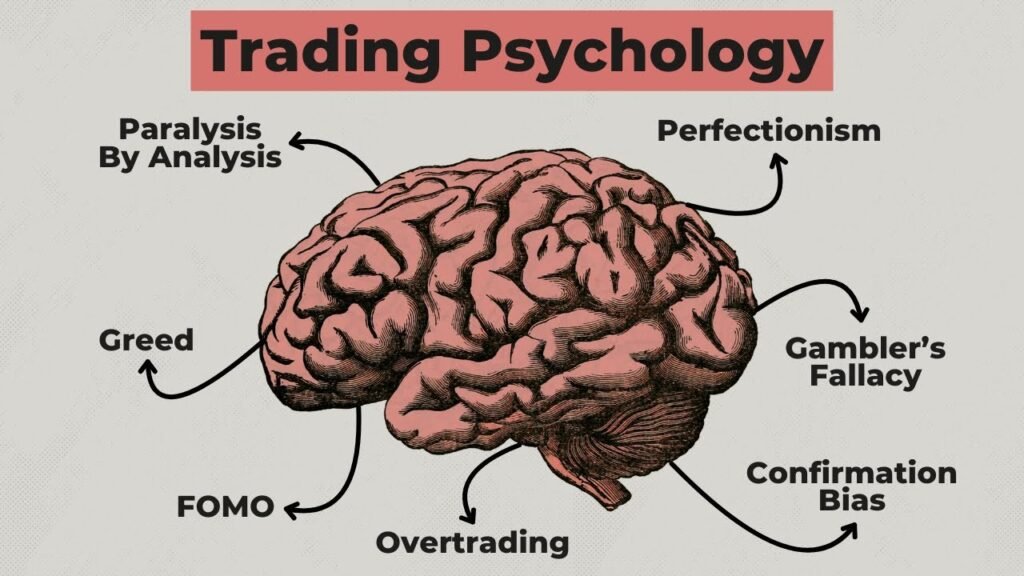
- Trading Psychology plays an important role in long-term success.
- Accept that no trading strategy wins every trade.
- Focus on following your trading plan instead of chasing profits.
- Stay patient while waiting for quality FVG setups.
- Avoid emotional trading after losses.
- Do not become overconfident after a series of winning trades.
- Control fear and greed in every market condition.
- Maintain realistic expectations about trading income.
- Learn from every losing trade.
- Keep a detailed trading journal.
- Develop discipline through consistent practice.
- Trust your strategy after proper backtesting.
- Never let one trade determine your confidence.
- Think like a professional trader instead of a gambler.
- A strong trading mindset supports consistent performance over time.
Real Example of a Fair Value Gap Trade
- Imagine the EUR/USD currency pair is moving in a strong uptrend.
- Price creates a large bullish candle, forming a Bullish Fair Value Gap (FVG).
- The gap appears between the first and third candles, leaving an imbalance.
- Instead of buying immediately, the trader waits for price to retrace into the FVG.
- Price returns to the gap during a temporary pullback.
- A bullish engulfing candle forms inside the Fair Value Gap.
- The trader enters a buy trade after receiving confirmation.
- A stop-loss is placed below the recent swing low.
- The take-profit is set near the next resistance level.
- The trade follows the direction of the overall market structure.
- Risk is controlled using a 1:2 or 1:3 risk-to-reward ratio.
- Price resumes the uptrend after respecting the Fair Value Gap.
- The trader exits the position according to the trading plan.
- The trade is recorded in a trading journal for future review.
- This example shows how patience, confirmation, and risk management work together to create a high-probability FVG trade.
Benefits and Limitations of the FVG Strategy
Benefits
- Fair Value Gaps provide high-probability trade entry areas.
- They help traders understand market imbalances.
- FVGs can improve the overall risk-to-reward ratio.
- They reduce emotional and impulsive trading decisions.
- The strategy works in Forex, Stocks, Crypto, Commodities, and Indices.
- FVGs can be used on multiple timeframes.
- They fit well with ICT trading concepts.
- They encourage traders to wait for pullbacks instead of chasing price.
Limitations
- Not every Fair Value Gap will be respected by the market.
- False signals may occur during low-volume trading sessions.
- Beginners may identify FVGs incorrectly.
- Trading without confirmation increases the chance of losses.
- Major news events can invalidate an FVG setup.
- The strategy requires patience and consistent practice.
- FVG works best when combined with Market Structure, Liquidity, and proper Risk Management.
Final Tips for Beginners
- Learn the basics of Fair Value Gaps before risking real money.
- Practice identifying FVGs on historical charts every day.
- Begin trading on a demo account.
- Always trade in the direction of the main trend.
- Use Market Structure for additional confirmation.
- Combine FVG with Order Blocks and Liquidity Zones.
- Never ignore Risk Management rules.
- Keep your risk small on every trade.
- Wait patiently for high-quality setups.
- Avoid overtrading because of excitement.
- Create a written trading plan and follow it consistently.
- Review your trades regularly to improve your strategy.
- Continue learning through chart practice and market observation.
- Stay disciplined even after a series of winning trades.
- Consistency, patience, and continuous learning are the keys to becoming a successful FVG trader.
Conclusion
The Fair Value Gap (FVG) Trading Strategy for Beginners is a practical method for understanding how price moves after a market imbalance. Instead of chasing every market movement, traders learn to wait for price to return to an area where buyers and sellers were previously out of balance. This approach helps improve trade timing and supports better decision-making.
Throughout this guide, you learned what a Fair Value Gap is, how it forms, how to identify bullish and bearish FVGs, the best timeframes for trading, how to combine FVG with Market Structure, and why proper Risk Management is essential. You also discovered the common mistakes beginners should avoid and the importance of maintaining discipline and emotional control.
No trading strategy can guarantee success on every trade. However, by combining Fair Value Gaps, Market Structure, Liquidity, Order Blocks, and sound Risk Management, traders can build a structured trading plan with greater confidence. Continue practicing on a demo account, review your trades regularly, and focus on long-term consistency rather than short-term profits. With patience and continuous learning, the FVG Trading Strategy can become a valuable part of your overall trading approach.
FAQs
1. What is a Fair Value Gap (FVG) in trading?
A Fair Value Gap (FVG) is a price imbalance created by a strong market move. Traders use it to identify potential areas where price may retrace before continuing its trend.
2. Is the Fair Value Gap strategy good for beginners?
Yes. The FVG strategy is suitable for beginners because it teaches traders how to identify market imbalances, improve trade entries, and apply proper risk management.
3. Which timeframe is best for Fair Value Gap trading?
The Daily, 4-Hour, and 1-Hour timeframes are generally considered the most reliable for identifying high-quality Fair Value Gaps. Lower timeframes can be used for precise entries.
4. Can Fair Value Gaps be used in Forex and Crypto trading?
Yes. Fair Value Gaps work in Forex, Cryptocurrency, Stocks, Indices, and Commodities because they are based on price action rather than a specific market.
5. Should Fair Value Gaps be used alone?
No. For better trading accuracy, combine Fair Value Gaps with Market Structure, Liquidity, Order Blocks, Support and Resistance, and strong Risk Management.

Pingback: Liquidity Sweep Trading Strategy Explained Guide
Thank you for reading! 😊 We’re glad you found the article helpful. Liquidity Sweep Trading is a powerful Smart Money Concept that can significantly improve your market analysis and trade entries when combined with proper risk management. If you have any questions, feel free to ask—we’re happy to help. Happy trading! 📈
WhatsApp: +92 341 3111134